Mold & Contamination on a Panamera.
Restored to Showroom.
A Porsche Panamera arrived at DShine Details covered in heavy mold growth and organic contamination across every exterior panel — the result of prolonged exposure to South Florida's humid climate under tree cover. Here's the full decontamination and correction process.
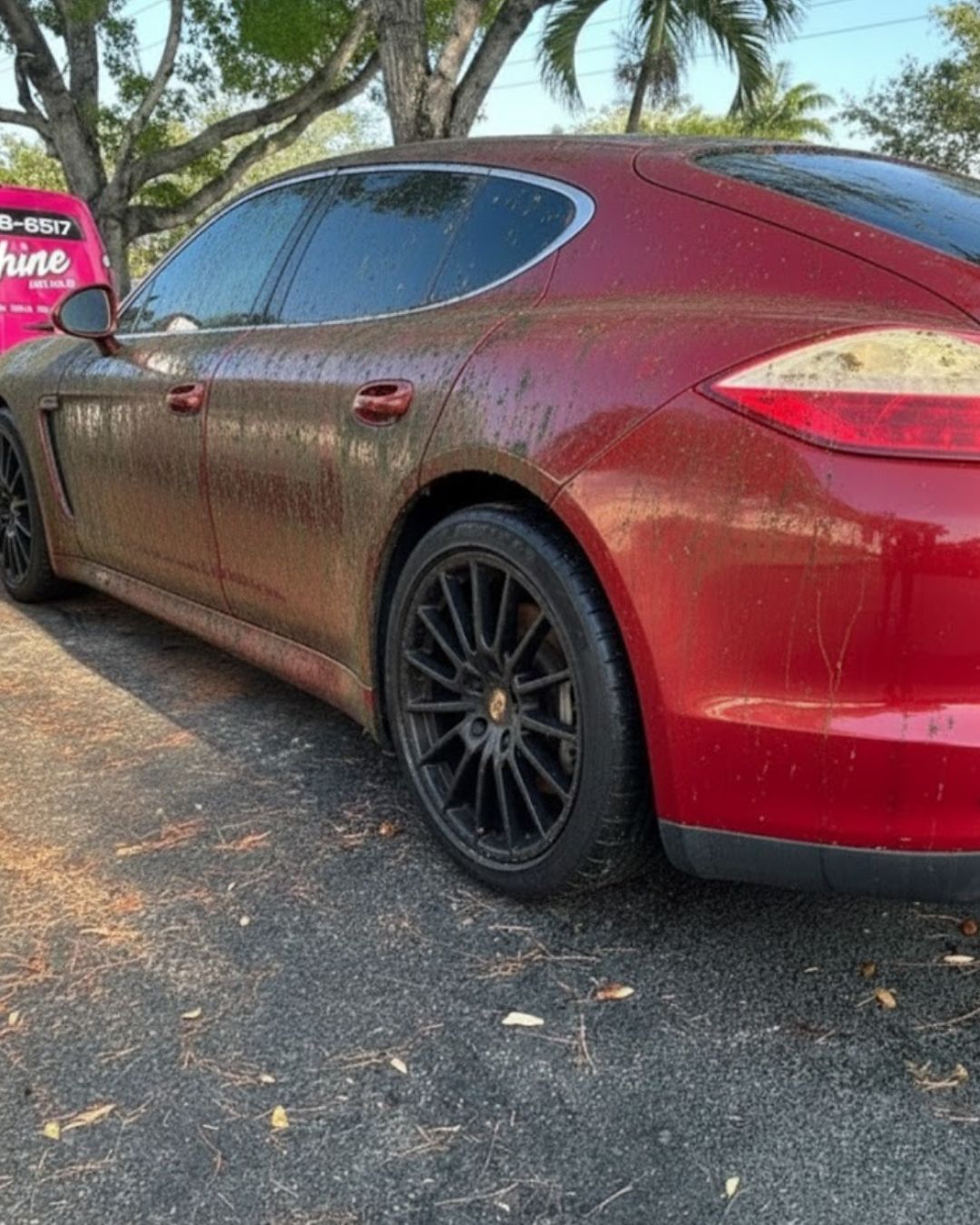

When South Florida Humidity Meets a Porsche Left Under a Tree
South Florida's climate is unforgiving on unprotected automotive paint. High humidity, intense heat cycling, and year-round organic debris from tree cover create the perfect conditions for mold and biological contamination to take hold on a car's exterior. On this Porsche Panamera, extended parking under tree cover had allowed a dense layer of mold spores, organic matter, pollen, and tree fallout to colonize every horizontal and vertical panel — bonding to the clear coat through repeated heat and moisture cycles.
What might look like simple dirt from a distance is actually a biologically active contamination layer that chemically attacks the clear coat from the outside in. Mold produces acids as it grows — and left untreated on a Porsche's thin OEM clear coat, these acids etch the surface permanently. The organic matter also traps moisture against the paint, accelerating oxidation and UV degradation even on panels not directly exposed to sunlight.
The contamination profile on this Panamera required a strict sequential approach. Attempting machine correction on a contaminated surface drags biological and chemical particles across the clear coat under polishing pressure — turning a contamination problem into a scratch problem. Full chemical decontamination and clay bar treatment had to be completed and verified before any correction work began.
Why Mold Is a Serious Threat to Porsche Paint
Porsche's OEM paint systems use a thinner clear coat than many mainstream manufacturers. Mold-produced acids and organic etching work faster on this thinner layer — what takes months to cause permanent damage on a standard vehicle can etch a Porsche clear coat in weeks under South Florida conditions. Early intervention is the difference between a correction job and a respray.
Eliminate the Biology First. Then Correct the Paint.
Paint Thickness Assessment
Before any product touches the Panamera, we measured paint thickness across every panel using a professional paint depth gauge. This step is mandatory on any high-value vehicle — and non-negotiable on a Porsche. The readings establish how much clear coat correction headroom exists on each panel and confirm whether the mold-related etching had already compromised the clear coat depth. We correct within safe limits — never to zero.
Full Biological & Chemical Decontamination
With the paint profile established, we began the decontamination sequence. First, an antifungal treatment was applied across all affected panels and allowed to dwell — killing the active mold colony and neutralizing biological acids before they could be disturbed and spread. Following this, iron remover was applied to draw out embedded metal particles, with the purple bleed reaction confirming extraction. An organic dissolvent then broke down the bonded sap and tree debris. Finally, a medium-grade clay bar was worked panel by panel, physically lifting any remaining surface contamination. Only with a genuinely clean, biologically neutral surface did we proceed to machine correction.
Stage One: Paint Correction
With the surface fully decontaminated, the correction pass began. A cutting compound with a foam cutting pad on a dual-action polisher was used to address the etching and swirl marks left behind by the mold acids and organic contamination. Working in 18"×18" sections under LED inspection lamps, each panel was worked until surface etching was eliminated and confirmed clear under multi-angle inspection lighting. The discipline here is restraint — on a Porsche Panamera's thin clear coat, reading the paint's response and adjusting aggression panel by panel is what separates a professional result from permanent damage.
Stage Two: Refining & Gloss Maximization
After the cutting stage, the paint surface — while free of etching and contamination damage — carries fine haze and micro-marring from the cutting compound. The finishing pass used a fine polish with a soft finishing pad, working the same panel sections to remove all traces of cutting haze and maximize the depth of gloss in the paint. This is the stage where the Panamera's true red reappears — deep, saturated, and reflective. Under direct South Florida sunlight, the transformation from a mold-covered surface to this level of gloss is what makes the before-and-after so striking. A two-stage process is the only way to achieve it.
Showroom Depth. Zero Scratches.
When the Panamera was completed and inspected under direct sunlight and inspection lamps at every angle, the mold, contamination, and surface etching were entirely eliminated from all panels. The organic bonding, iron fallout, and swirl marks had been fully removed. What remained was the pure, unobstructed gloss that Porsche's paint system is capable of — deep, red, reflective, and visually flawless at every angle.
The client received full before-and-after documentation via WhatsApp along with a maintenance protocol: a ceramic coating application was strongly recommended at the follow-up service to create a hydrophobic barrier that prevents mold spores and organic matter from bonding to the paint surface again. Without a protective layer, South Florida's humidity will return the same contamination to an unprotected clear coat — correction solves the past; coating protects the future.
The Specifics That Matter on a Mold-Damaged Porsche
Mold and biological contamination on a luxury vehicle like the Panamera is not the same problem as dirt. Here's why it requires a specialist approach.
Mold Produces Acid. Acid Etches Clear Coat.
Active mold on automotive paint isn't a cosmetic issue — it's a chemical one. Mold colonies produce organic acids as a byproduct of growth, and on Porsche's thin OEM clear coat those acids etch the surface permanently over time. Early professional intervention is the difference between a decontamination job and a full panel respray.
Decontaminate Before You Correct. Always.
Running a machine polisher over a mold-contaminated surface drags biological particles and organic acids across the clear coat under pressure — converting surface contamination into physical scratches. The decontamination sequence is not optional preparation; it is the foundation that makes correction possible without causing additional damage.
Correction Fixes the Past — Ceramic Coating Stops It Returning
Paint correction removes existing contamination and damage. It does not prevent future mold growth. A ceramic coating creates a hydrophobic, chemically resistant barrier over the corrected clear coat — dramatically reducing the ability of mold spores and organic matter to bond. In South Florida's climate, coating after correction is not a luxury; it is the logical next step.
Your Paint Can Be
This Good Again.
Whether it's mold, tree contamination, swirl marks, or years of South Florida humidity — decontamination and paint correction restores what you thought was permanent damage.